

Latest Developments in Robotic Welding Technology: Industry 4.0 Guide

Author
Latest Developments in Robotic Welding Technology: Advanced Manufacturing Solutions
Your welding operations face enormous pressure to deliver perfect weld quality while maintaining production speed and protecting your workforce from dangerous conditions. Manual welding introduces variability in weld quality, limits production speed, and exposes your team to hazardous fumes and intense heat. Modern robotic welding technology revolutionizes your fabrication operations through exceptional consistency, dramatically increased throughput, and revolutionary safety improvements that protect your workforce while delivering superior product quality.
In this comprehensive guide, you'll explore the latest developments in robotic welding and discover how to implement these advanced systems to transform your competitive position.
Understanding Modern Robotic Welding Systems
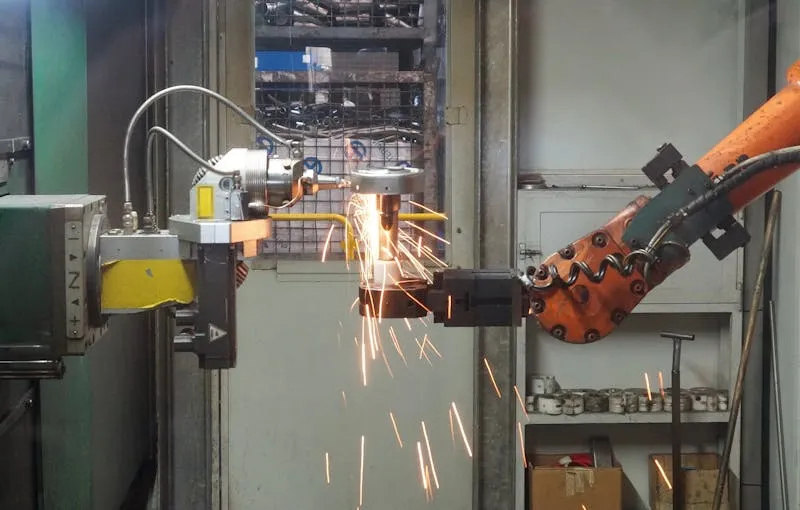
Robotic welding systems are automated solutions that perform arc welding, resistance spot welding, or laser welding with precision that exceeds the most experienced human welders. These systems use computer-controlled industrial robots equipped with specialized welding equipment to join metal components with perfect consistency, batch after batch.
Your robotic welding system operates across multiple industries including automotive manufacturing, heavy equipment production, construction machinery, shipbuilding, aerospace, and general metal fabrication. Whether you're performing MIG/MAG welding, TIG welding, spot welding, or laser welding, modern systems deliver exceptional results.
The welding industry has embraced robotic automation extensively. Currently, over 120,000 robotic welding systems operate in manufacturing facilities worldwide, with adoption continuing to accelerate. Companies implementing robotic welding report quality consistency improvements of 35-45%, production speed increases of 200-350%, and labor cost savings of 50-70% in welding operations.
Key Advantages of Robotic Welding Systems
Perfect Weld Consistency and Quality
Your robotic welding system delivers 98% weld quality consistency, ensuring every weld meets your specifications precisely. This level of consistency is impossible to achieve with manual welding. Your benefits include:
- Identical weld penetration and bead appearance across all components
- Defect rates below 0.5% compared to 2-5% for manual welding
- Repeatable results regardless of welder fatigue or experience variations
- Perfect compliance with the most demanding quality specifications
- Reduced rework and scrap rates by 60-80%
- Superior component reliability and product lifespan
Dramatically Increased Production Speed
Your robotic welding system increases throughput by 200-350% compared to manual welding through several factors:
- Faster weld travel speeds enabled by robot precision
- Zero downtime from fatigue or shift changes
- Optimized weld sequences that minimize cycle times
- Continuous 24/7 operation capability
- Instant transition between different weld specifications
This speed advantage means you complete more components per facility, effectively expanding your production capacity without facility expansion.
Exceptional Worker Safety
Your employees face serious hazards when performing manual welding. Arc flash, toxic fumes, heat stress, and ergonomic strain create substantial occupational health risks. Your robotic system eliminates these hazards by:
- Removing workers from exposure to welding arcs and intense heat
- Eliminating inhalation of toxic welding fumes and gases
- Preventing arc flash eye damage and skin burns
- Reducing heat stress and thermal fatigue
- Minimizing repetitive strain injuries from manual torch operation
- Improving overall workplace air quality through controlled ventilation
Substantial Cost Reduction
Your investment in robotic welding delivers impressive financial returns through multiple cost reduction channels:
- Labor cost reduction of 50-70% for welding operations
- Decreased defect and rework costs of 60-80%
- Reduced material waste through precise arc control
- Lower operational overhead through facility efficiency
- Extended equipment lifespan through optimized parameters
- Reduced worker compensation insurance costs
Latest Technological Developments in Robotic Welding
Understanding the latest innovations helps you select systems with cutting-edge capabilities:
AI-Powered Adaptive Welding: Modern systems use artificial intelligence to monitor weld parameters in real-time and adjust automatically for optimal results. Machine learning algorithms adapt to variations in material properties, joint fit-up, and environmental conditions.
Laser Seam Tracking: Advanced vision systems track the weld joint position continuously during welding, automatically adjusting torch position to maintain perfect seam alignment. This technology eliminates problems from inconsistent joint preparation and material variations.
Touch Sensing Technology: Your system's torch uses force-sensing technology to locate joint position before welding begins. Touch sensing enables accurate torch positioning even when joint preparation varies slightly.
Hybrid Welding Systems: Modern systems combine different welding technologies—laser with arc welding, for example—enabling superior results on challenging applications. Hybrid systems achieve higher speeds, better penetration control, and improved weld appearance.
Real-Time Quality Monitoring: Integrated sensors monitor arc current, voltage, travel speed, and wire feed rate during welding. Deviations from optimal parameters trigger adjustments, ensuring consistent weld quality. Data collection enables comprehensive quality documentation.
Collaborative Welding Robots: New cobot welding systems work safely alongside human workers, with humans handling complex or irregular joints while robots perform high-volume standard welds.
Digital Twin Technology: Advanced systems create digital replicas of your physical welding cells, enabling virtual testing of new products, processes, and parameters before real-world implementation.
Welding Technologies Your System Might Employ
Your robotic welding system might employ different technologies depending on your specific applications:
MIG/MAG Welding: Your system uses a continuously fed wire electrode with an inert or reactive gas shield. MIG/MAG welding is fast, versatile, and ideal for high-volume welding of steel, stainless steel, and aluminum.
TIG Welding: Your system uses a non-consumable tungsten electrode with separate filler wire. TIG welding produces high-quality welds on stainless steel, aluminum, and exotic materials, ideal for applications demanding superior weld appearance.
Spot Welding: Your system uses resistance heating and force to create weld nuggets at specific points. Spot welding is ideal for high-speed assembly of sheet metal components, particularly in automotive manufacturing.
Laser Welding: Your system uses a high-powered laser beam to melt and fuse materials. Laser welding produces exceptionally narrow, high-quality welds ideal for precision applications and dissimilar materials.
Electron Beam Welding: Your system uses focused electron beams to create deep, narrow welds. Electron beam welding excels on thick materials and specialized applications requiring exceptional penetration.
Applications Where Robotic Welding Excels
Your robotic welding system delivers exceptional value across numerous manufacturing scenarios:
- Automotive manufacturing—high-speed welding of vehicle frames and components
- Heavy equipment production—welding large structural assemblies for construction and mining equipment
- Shipbuilding—welding hull sections and structural components with consistent quality
- Aerospace fabrication—precision welding of aircraft components meeting strict specifications
- Metal fabrication—general-purpose welding of structural steel, stainless steel, and aluminum
- Pressure equipment—welding boilers, tanks, and vessels requiring exceptional quality
- Pipe and tube fabrication—longitudinal seam welding at high speeds with consistent penetration
Implementation Strategy for Robotic Welding Systems
Your successful robotic welding implementation follows a structured approach:
1. Analyze Your Current Welding Operations: Evaluate your current production rates, weld quality, labor costs, material waste, and capacity constraints. Establish baseline metrics that demonstrate automation benefits.
2. Define Your Welding Requirements: Specify material types, joint configurations, weld sizes, production volumes, and quality standards. Document your most challenging welding applications for special system consideration.
3. Select Appropriate Welding Technology: Different applications benefit from different welding processes. MIG/MAG excels at high-speed general welding, while TIG produces superior weld appearance on critical applications. Laser welding handles special applications. Consult with experts to select the optimal technology.
4. Design Your Robotic Cell: Your system design considers component fixtures, torch positioning, part presentation, heat management, and worker safety. Proper design maximizes efficiency while ensuring safe operation.
5. Plan Integration with Your Manufacturing System: Your robotic welding system must integrate with upstream material handling and downstream assembly operations. Plan coordinated workflows that maximize overall efficiency.
6. Professional Installation and Commissioning: System installation requires expertise in electrical integration, gas supply management, cooling system setup, and safety validation. Professional installation ensures optimal performance from startup.
Real-World Performance Improvements
Companies implementing robotic welding systems achieve these measurable results:
- 98% weld quality consistency
- 200-350% increase in welding speed compared to manual operations
- 60-80% reduction in defect and rework costs
- 50-70% reduction in labor costs for welding operations
- 18-36 month payback period
- 35-45% improvement in first-pass yield
- 90% reduction in safety incidents related to welding
These results come from actual implementations across diverse industries and welding applications.
Overcoming Implementation Challenges
Your robotic welding implementation might face obstacles requiring strategic solutions:
Complex Joint Geometry: Parts with multiple joint orientations and complex geometry require sophisticated torch positioning and motion planning. Advanced programming and sensor technology solve most complex geometry challenges.
Variable Material or Joint Preparation: Inconsistent material properties or joint fit-up create weld variability. Adaptive control systems and touch sensing technology automatically adjust parameters to maintain consistent results.
Space Constraints: Your facility might have limited space for large robotic cells. Compact robot configurations and creative facility layout maximize your available space.
Quick Changeover Requirements: If your operation produces diverse products with different welding requirements, fast changeover capability is essential. Modern systems reprogram relatively quickly, though some products might require fixturing adjustments.
Existing Equipment Integration: Your legacy conveyor systems or part handling equipment might require integration with new welding robots. Professional integrators bridge compatibility gaps to create seamless operation.
Maximizing Your Robotic Welding Investment
After deployment, optimize your system continuously:
Monitor Weld Quality Metrics: Track defect rates, rework costs, first-pass yield, and weld appearance. Regular monitoring identifies opportunities for parameter optimization.
Implement Preventive Maintenance: Scheduled maintenance prevents unexpected downtime and extends equipment lifespan. Most systems require 6-10 hours of maintenance monthly, including contact tip replacement, gas nozzle cleaning, and cable inspection.
Optimize Welding Parameters: As you gain operational experience, refine current settings, travel speeds, and wire feed rates. Small parameter adjustments sometimes yield significant quality improvements.
Keep Logs and Documentation: Maintain detailed records of weld parameters for each product type. This documentation enables consistent quality and supports effective troubleshooting when issues arise.
Invest in Operator Training: Your operators need comprehensive training on robot programming, parameter adjustment, safety procedures, and basic troubleshooting. Well-trained operators extract maximum value from your investment.
Integration with Your Broader Manufacturing Strategy
Your robotic welding systems deliver maximum value within a comprehensive automation ecosystem. Consider integration with:
- Automated Assembly Lines for complete production automation
- Pick and Place Automation Solutions for component positioning before welding
- Material handling systems for efficient component presentation
- Quality inspection systems for weld verification
- Painting systems for finished component coating
This integrated approach creates a seamless manufacturing operation from component fabrication through finished product delivery.
Future Trends in Robotic Welding Technology
Your investment in robotic welding positions you to benefit from emerging innovations:
Advanced AI and Predictive Analytics: Future systems use machine learning to predict component fatigue and failure, enabling predictive maintenance and optimal weld parameter selection.
Collaborative Welding: Human workers and welding robots collaborate in shared spaces, with robots handling high-volume standard welds while humans manage complex or custom requirements.
Additive-Subtractive Welding: Emerging systems combine welding (additive) with machining (subtractive) to create near-net-shape components, reducing downstream machining.
Sustainability Focus: Future systems optimize energy consumption, reduce shielding gas waste, and minimize spatter through advanced process control.
Supply Chain Integration: Real-time data flows from your welding operation to your supply chain, enabling just-in-time material delivery and optimized inventory management.
Getting Started with Robotic Welding Automation
Your journey toward manufacturing excellence through robotic welding begins with understanding your current welding operations and consulting with experienced automation specialists. Ulurob brings deep expertise in designing and implementing robotic welding systems across diverse industries and welding applications.
Start by evaluating your welding challenges, identifying efficiency opportunities, and discussing your vision with our team. We'll assess your specific requirements and develop a customized solution that delivers measurable returns through improved quality, reduced costs, and enhanced worker safety.
Frequently Asked Questions (FAQ)
How much does a robotic welding system cost?
Robotic welding systems typically range from €200,000 to €600,000+ depending on welding technology, production requirements, and facility integration complexity. When you calculate the ROI considering labor savings, defect reduction, and increased capacity, most systems achieve payback within 18-36 months. Ulurob provides transparent pricing and flexible financing options for various budgets.
How long does implementation take?
Standard robotic welding implementations typically take 4-6 months from design through full production operation. This includes cell design, equipment procurement, installation, software programming, integration testing, and operator training. Ulurob manages the entire process to minimize disruption to your existing operations.
What happens if my components have variable joint preparation?
Variable joint preparation can affect weld quality. Modern robotic welding systems address this challenge through touch sensing technology that automatically locates the joint before welding, and adaptive control systems that adjust parameters in real-time for optimal results. These technologies maintain consistent weld quality despite variations in joint fit-up.
Can robotic welding systems handle multiple product types?
Yes, modern robotic welding systems switch between different products through software reprogramming and fixturing adjustments. Changeover time depends on complexity but typically takes 30 minutes to several hours. If your operation produces multiple products, designing your system to handle product family groups minimizes changeover time.
What training do my operators need?
Your operators need comprehensive training including robot operation, program modification, parameter adjustment, safety procedures, and basic troubleshooting. Ulurob provides extensive operator training as part of system commissioning and offers ongoing support for advanced training as your operation expands. Well-trained operators extract maximum value from your investment and ensure consistent quality.